Trimble Earthworks: Automating Excavation and Grading
Author
Ashleigh
Category
Blog
Reading Time
Date Published
27 February, 2026
Get In Touch
Excavation and grading sit at the heart of every earthworks project. When these stages run efficiently, everything that follows moves faster. When they don’t, small inefficiencies compound and begin to affect both timelines and budgets. Trimble Earthworks was developed to remove those bottlenecks by bringing automation and digital control directly into the cab.
By integrating excavation control with automated dozing and 3D guidance, the system helps contractors get it right the first time. That accuracy translates into faster cycles and lower operating costs.
Instead of relying on constant manual checks and operator estimation, machines work from a shared digital design supported by Trimble construction technology solutions that keep every pass precise and productive.
How Trimble Earthworks Improves Excavation Accuracy
Traditional excavation relies heavily on operator experience and repeated grade checks. This approach can introduce variability and slow progress as crews pause to verify levels and make corrections.
-
Real-time machine guidance gives operators continuous cut-and-fill visibility.
-
Target grades can be achieved without over-excavation or unnecessary material movement.
-
Consistent site depth reduces the need for repeated verifications, improving productivity and limiting material waste.
Dozer Automation That Reduces Operator Workload
Dozer automation is one of the most powerful advantages of modern machine control systems. Instead of manually adjusting blade position on each pass, the system automatically controls blade movement using a grade-control platform for dozers based on the digital terrain model.
This results in:
-
Smoother finishes with reduced rework.
-
Less operator fatigue during long shifts.
-
More consistent results from all operators.
Automating blade adjustments lets operators focus on positioning and safety, delivering faster and more predictable outcomes.
The Role of 3D Guidance in Grading Precision
3D guidance provides operators with real-time clarity on material needs, so grading follows the design from the first pass. The system continuously updates machine positions and grade requirements, removing the need for physical markers or repeated checks. Consistent visual feedback maintains accuracy across changing surfaces and conditions, enabling efficient, consistent grading with less rework.
Manual Grading vs. Automated Grading Systems
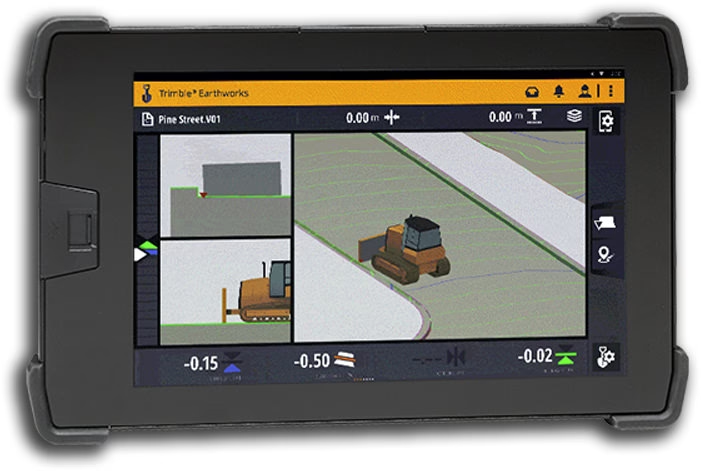
The difference between manual grading and automated machine control becomes clear when comparing performance across key site metrics.
| Feature | Manual Grading | Trimble Earthworks Automation |
|---|---|---|
| Accuracy | Operator-dependent | Digitally guided and consistent |
| Cycle Time | Slower, variable | Faster with fewer passes |
| Material Waste | Higher | Significantly reduced |
| Labour Demand | High | Reduced reliance on manual checks |
| Error Correction | Reactive | Real-time adjustment |
Automation doesn’t replace skilled operators – it enhances their capability and ensures consistent results across every phase of the project.
These gains are driven by digital workflows that connect design data directly to machines, a core principle behind modern construction automation systems.
How Automation Reduces Cycle Time and Costs
Automation enhances operator skills and delivers reliable results throughout projects.
Key cost-saving areas include:
-
Faster cycle times: Automated machines reach final grade sooner, allowing teams to complete more work within the same timeframe and improve overall project performance.
-
Lower fuel consumption: Efficient machine control reduces unnecessary movement, cutting fuel usage and lowering operating expenses over the life of a project.
-
Reduced labour costs: With fewer manual checks and adjustments required, crews can be deployed more effectively across the site without compromising quality.
-
Fewer mistakes and rework: Accurate guidance reduces grading errors, preventing costly rework and keeping projects on schedule.
-
Improved material management: Precise excavation control minimises overcutting and material waste, helping budgets stay intact and sites run more efficiently.
These efficiencies make automation easy to justify and practical on-site.
Workflow Integration for Automated Earthworks

Successful implementation begins with selecting compatible machines and installing the system components. After installation, calibration is performed to ensure accurate positioning and blade control. Verification of the digital design and calibration allows the machines to follow project plans from the outset.
Operator training is the next step. Teams are instructed on how to read digital designs and operate guidance displays, enabling them to work efficiently with the automated system. Productivity gains can be measured once operators are trained. Periodic review of performance data helps contractors identify areas to fine-tune and optimise workflows for ongoing projects.
Ongoing setup and optimisation can be sourced through the technical support page when site conditions or project requirements change.
Common Questions Contractors Ask About Automation
Before adopting automated excavation and grading, contractors want clarity on impact, flexibility and equipment compatibility.
The questions below address the most common concerns when moving from manual to digitally guided machine control.
Improve Site Efficiency With SITECH SA
If your goal is to reduce cycle time, control costs and enhance grading accuracy, Trimble Earthworks offers a practical step forward. SITECH SA works closely with contractors to ensure the system is correctly implemented and supported throughout its lifecycle.
Connect with our team to explore how automated machine control can be implemented on your site.
Need to get in touch with us?
Complete the form and a member of our team will be in touch.
Alternatively, you can contact any of our regional offices directly using the details below.
Request a Quotation
Please complete the form and a SITECH SA representative will contact you to assist.