
Bark, Mulch and Compost
Measuring loose material accurately

Loadscan’s products are exported globally to bark, mulch and compost suppliers across the globe.
If you’re unknowingly oversupplying because you’re unable to measure loose material accurately, you’ll be doing your bottom line no favours.
The LVS system reports the actual loose volume of the load as it sits in the truck at the time of measurement, regardless of how it was loaded or how heavy or wet the material is. Improved load measurement and inventory monitoring means you won’t run the risk of huge product write-offs come stocktake.
Volume scanning delivers extensive benefits
- Ensure you only pay for the material you receive
- Don’t pay for water content in incoming material
- Determine accurate product densities by combining measured volume and weight data, not estimates based on inaccurate conversion factors
- Accurate sold volumes improves customer satisfaction and retention, and eliminates oversupply
- Proven accurate to +/- 1% (Certified for Trade in NZ and Australia)
- Eliminate disputes or withheld payments over volumes
- Optimize truck loading for maximum asset utilization and profitability
- Easily access historical period reporting for invoicing, stock reconciliation and performance analysis
- No significant maintenance costs or re-calibration required
Inaccurate compaction and bulking factors can reduce profits
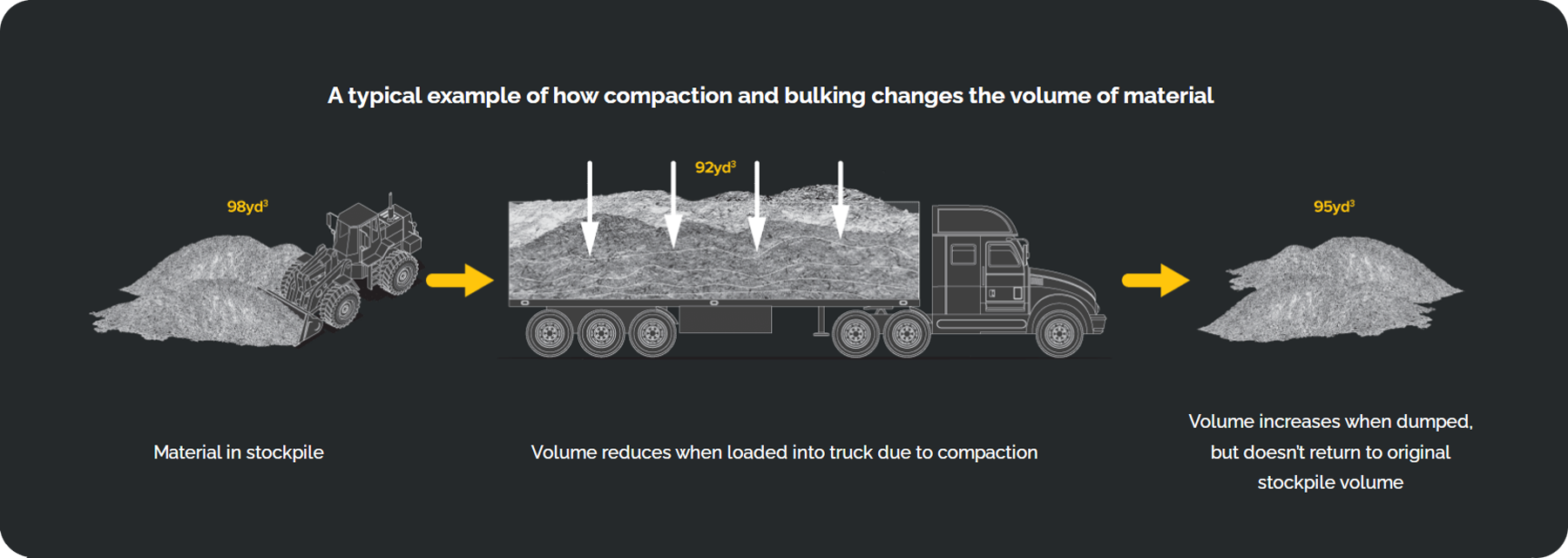
Every supplier and manufacturer has a somewhat unique situation, where material is affected to different degrees by factors such as moisture, size of the pile, how long the pile has been settled, and type of material. Using common bulking and compaction factors provide generic estimates only, and don’t necessarily reflect the actual state of your material.
Incorrectly estimated or misunderstood factors can significantly reduce profits due to material measurement inaccuracies on incoming and outgoing loads.
One cubic yard in the stockpile does not translate into one cubic yard in the truck, nor one cubic yard when dumped.
Material from the stockpile tends to compact when loaded into a truck bin. When the material is unloaded at the destination it tends to bulk up, but usually not the the same volume that was extracted from the original stockpile. This makes accurate loose measurement challenging.
Without accurate factors to determine the true volume of loose material in a truck bin you could be paying for material you haven’t actually received, or you could be oversupplying your customers.
The Loadscan LVS gives you the ability to accurately determine and apply your own compaction and bulking factors of each of the materials you receive and supply, making it the only reliably accurate method of measuring volumes.
Ensure you only pay for the material you receive
Because you purchase material in cubic volume, you need a reliable and accurate method of checking that the actual volume of material you’re receiving is correct, not a supplier estimate.
Common methods of determining truck load volumes, such as counting loader buckets or truckloads, or converting from weight are inaccurate. Survey quantities don’t account for compaction factors in material loaded into a truck from a stockpile, nor bulking of the material when it’s unloaded. With a Loadscan LVS system you’ll end supply disputes, which can be frustrating, time consuming and expensive.
Volumetric laser scanning is the only accurate and consistent load measurement method.
Typical load scanning system components

