Loadrite Retrofits: Upgrading Old Machines With Smart Weighing Tech

Author
Ashleigh
Category
Blog
Reading Time
Date Published
27 April, 2026
Get In Touch
Older machines work reliably, but capturing accurate, real-time data from them is a challenge.
Loadrite retrofits solve this by adding smart weighing systems to existing loaders and excavators, enabling better accuracy and more informed decisions on site. For operations looking to extend asset life while improving performance, retrofitting offers a practical path forward.
Why Loadrite Retrofits Make Sense for Legacy Machines
Many sites still rely on machines that are mechanically sound but lack modern technology. Full equipment replacement is often costly and not always necessary. Loadrite retrofits bridge that gap by providing a practical legacy machine upgrade that brings weighing intelligence to older equipment without disrupting operations or requiring a full upgrade cycle. This allows operators to improve load accuracy while reducing overloading and underloading. Instead of renewing older machines, you’re enhancing them.
Loadrite Retrofits vs Replacing Equipment
When deciding how to upgrade your fleet, the choice often comes down to retrofitting existing machines or investing in new equipment. The differences become clear when you compare cost and time, along with the overall operational impact.
| Factor | Loadrite Retrofit | New Machine |
|---|---|---|
| Cost | Lower upfront investment | High capital cost |
| Implementation Time | Quick installation | Long procurement cycle |
| Operational Disruption | Minimal | High during transition |
| Technology Upgrade | Adds smart weighing capability | Full system upgrade |
| ROI Timeline | Faster due to quicker payback | Slower due to higher investment |
Because retrofitting increases efficiency with less downtime and lower costs than equipment replacement, many operations consider it a practical, cost-effective improvement that minimises production delays.
What a Loadrite Retrofit Actually Includes
A retrofit is designed to work with your existing machine while adding real-time weighing capability and performance visibility. These systems can be applied across loaders and other material handling equipment, depending on the operation.
-
1. Onboard Weighing Hardware
Sensors are installed directly onto the machine to measure load weight during operation. These systems are built to handle tough site conditions without affecting performance.
-
2. In-Cab Display Systems
Operators receive immediate feedback through a clear in-cab interface. This allows for quick adjustments and more consistent loading without slowing down the cycle.
-
3. Reporting and Data Tracking
Some systems include reporting functionality, giving managers access to load data and a clearer view of productivity trends over time. This data can be used to monitor site activity and support more informed operational decisions.
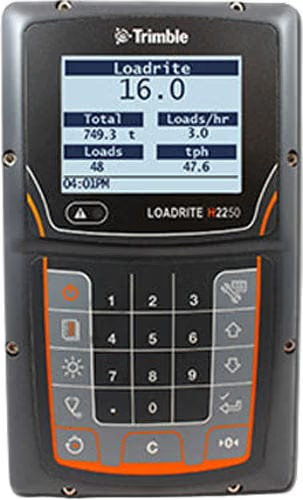
For a closer look at available systems, explore the Loadrite solutions offered by SITECH South Africa and how they apply across different machines.
Improving Accuracy With Onboard Scale
Without onboard weighing, operators often rely on estimation. That leads to inconsistent loads, which affect productivity and can increase equipment wear.
Onboard scales remove the guesswork.
Each load is measured in real time, giving operators immediate feedback. This helps maintain consistent payloads and reduces the need for rehandling material. Systems like the Loadrite L2180 onboard scale system are designed to deliver this level of accuracy during normal loading operations.
Over time, that consistency cuts unnecessary trips and improves fuel efficiency. It also lowers strain on machines and supports compliance with load limits, helping maintain safer operating conditions on site.
This kind of control doesn’t just improve individual loads; it changes how the entire operation performs.
Onboard Weighing Retrofits and Operational Efficiency
Efficiency is not just about speed. It’s about having better control over how work is carried out on site. With machine retrofit solutions, operators can maintain more consistent loading without relying on estimation. This supports smoother workflows and helps keep operations running predictably. For managers, the benefit is greater oversight. You can track how material moves across the site, identify performance gaps, and make informed adjustments where needed. This level of control is difficult to achieve with legacy machines alone.
Understanding Retrofit ROI
One of the biggest questions about retrofitting is the cost-versus-return trade-off. The value comes from how quickly improvements show up in day-to-day operations.
-
Reduced Material Loss: More accurate loading prevents overfill and underfill, limiting wasted material.
-
Lower Fuel Usage: Consistent loading avoids unnecessary cycles, helping machines run more efficiently over time.
-
Less Equipment Strain: Avoiding overload protects components and reduces wear over time.
-
Improved Output Per Machine: Each machine operates more efficiently, increasing overall site productivity.
These gains accumulate, often yielding returns sooner than expected.
Where Retrofits Work Best
When looking at Spectra vs Trimble in practice, the differences become clearer through how teams work on-site.
Retrofitting is particularly useful in environments where material movement is constant and accuracy matters.
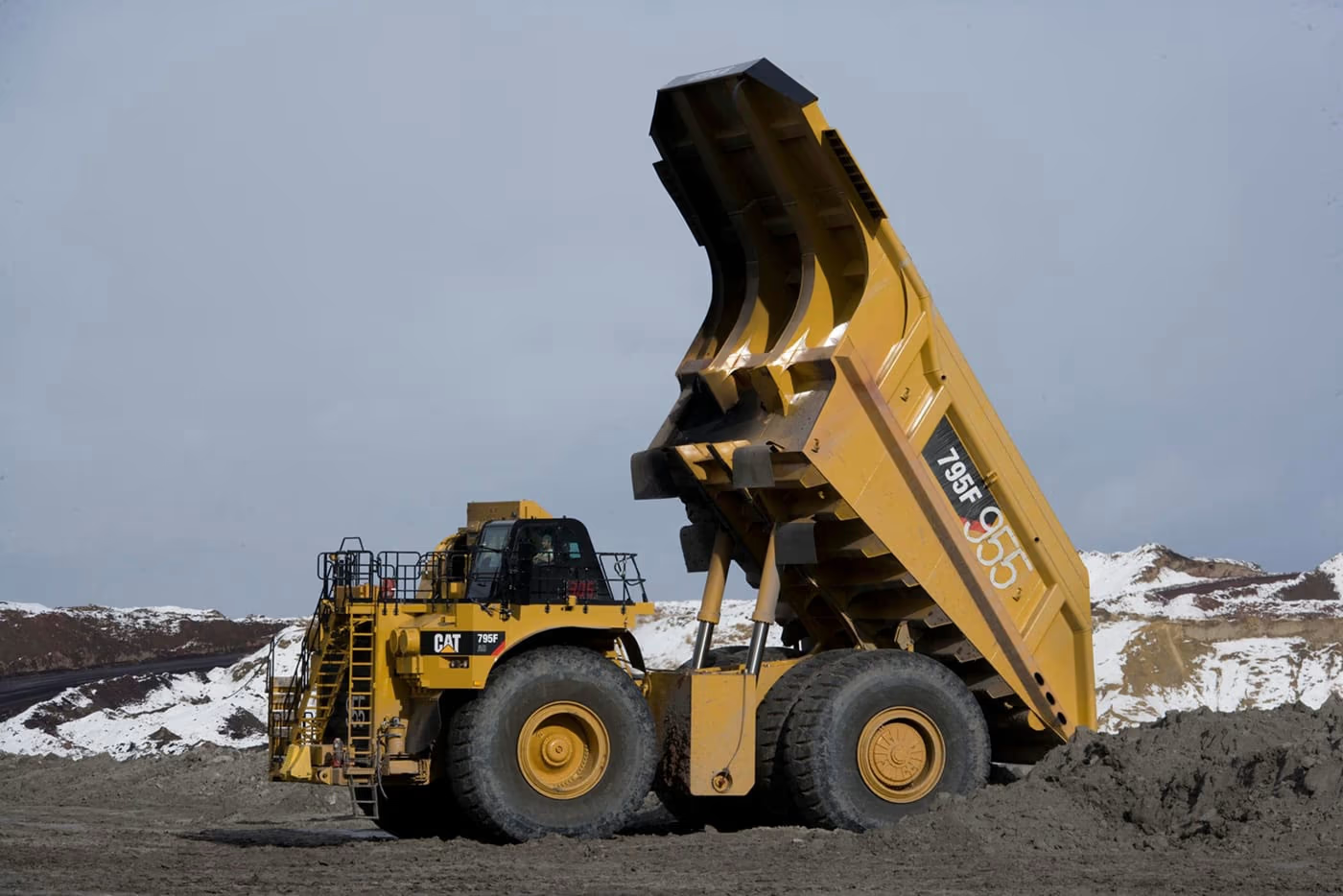
Retrofitting is widely used across quarries and mining operations. It is also common in construction environments and waste or recycling sites, where consistent loading and material tracking are essential.
For higher-volume operations, systems such as the Loadrite H2250 onboard weighing system are designed to handle more demanding loading environments while maintaining accuracy.
Retrofitting Without Disrupting Operations
A key advantage of Loadrite retrofits is the minimal disruption they cause. Installation is typically quick, with systems designed for seamless integration into your existing setup. Operators can be trained on-site, so teams can rapidly adopt the technology with minimal impact on ongoing production, keeping operations moving smoothly. This makes it easier to roll out upgrades across multiple machines over time.
Is Retrofitting Older Machines Worth It?
If your machines are still mechanically reliable, the answer is often yes.
Retrofitting extends your fleet’s life and performance without major capital investment, bringing older equipment closer to modern standards.
The decision comes down to how much value you can unlock from assets you already own. For many operations, Loadrite retrofits offer a smart, low-risk way to improve both accuracy and efficiency.
Upgrade Your Fleet With SITECH South Africa
Modern performance doesn’t require new machines. With the right retrofit, you can quickly improve accuracy and efficiency.
Speak to SITECH South Africa to find the right solution for your equipment and operation, and get started with a smart weighing system upgrade today.
Need to get in touch with us?
Complete the form and a member of our team will be in touch.
Alternatively, you can contact any of our regional offices directly using the details below.
Request a Quotation
Please complete the form and a SITECH SA representative will contact you to assist.