Unlocking hidden value with Loadscan at a Coal Mining Contractor

Author
Stephen Brown
Category
Blog
Reading Time
Date Published
28 October, 2025
Get In Touch
A contractor that operates a mine in Mpumalanga suspected underloading was occurring, but believed it was minimal, no more than 5% on average. That assumption shaped both their day-to-day planning and their long-term expectations. If trucks were running light, they reasoned, it was within a tolerable margin.
The proof of value was meant to confirm that reasoning, provide a sharper measurement and perhaps reveal ways to tighten consistency.
Setting up the Trial
The trial was deliberately contained. The Loadscan system was brought on site for a one-day scan, carried out between 24–25 July 2025.
SITECH SA oversaw the monitoring of a mixed fleet of trucks. In total, four hours and forty minutes of scanning were logged across both days, during which 112 loads were captured. To reflect real-world productivity, the data was extrapolated to simulate 17.34 hours of production per day.
The trial was framed as a proof of concept, quick, precise, and designed to give the company an accurate snapshot of what was happening in their load and haul operation. The expectation was simple: either validate the 5% assumption or highlight a small variance that could be adjusted.
The Loadscan System
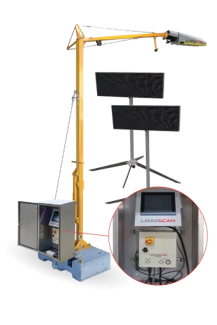
The Loadscan MPS (Mine Payload Scanner) is a volumetric measurement system that uses eye-safe Lidar laser scanning combined with proprietary Loadscan software to calculate the exact load profile and volume of material within a truck or trailer bin. By capturing a 3D surface scan of each load, the system provides precise real-time volumetric data. Each scan generates a visual audit trail, enabling accurate monitoring of material movement, verification of payloads, assessment of load distribution, and analysis of loading practices.
This level of measurement accuracy reduces disputes over delivered quantities and enhances overall haulage efficiency.
The Numbers don’t lie
The Loadscan data showed something quite different to the ongoing perception. Instead of a minor 5% gap, the mine was running light by closer to 15% on average. Across the fleet, average load volumes fell consistently below target benchmarks, with shortfalls ranging from -2.4 m³ to -4.9 m³ against the SAE 2:1 standard.
Looking deeper into individual load records, the inconsistencies became clearer. Loads were fluctuating significantly, with minimum recorded loads of 16.9–17.7 m³ and maximums of 22.3–24.2 m³. Average figures for different truck types fell in the 19.9–21.5 m³ range, all significantly under their targets.
For the mine, it was a shock. Managers admitted the results were “a huge surprise”. The assumption of a 5% loss had shaped operational thinking, but Loadscan revealed the actual deficit was three times higher.
The Operational Cost of Underloading
Numbers on a spreadsheet can sometimes feel abstract, but in mining every cubic metre counts. Underloading doesn’t just mean smaller loads of coal in the back of a truck; it ripples across the operation. Every truck that runs light forces another to take its place. More trips are required, fuel burn increases while the running costs mount.
As the mining contractor acknowledged, underloading requires additional truckloads to haul material that should have been moved in the first place. In practical terms, this meant more hours behind the wheel, more wear on equipment, and more money spent moving the same volume.
The financial consequences were stark. Loadscan’s analysis put the value of the lost opportunity at over thirty-five million Rands, with an additional 22,882 truckloads per annum being run unnecessarily to compensate. The solution was comparatively modest: invest in a single Loadscan unit. The return? A payback period of just 24 days, based solely on the hauled volume.
Consistency and Safety
The trial also shone a light on the inconsistency of loading practices. While some trucks approached their targets, many others fell well short. These repeating patterns indicated not just inefficiency but missed opportunities for feedback. With proper measurement, operators could be guided toward more consistent loading, smoothing out the peaks and troughs in the data.
Although safety was not a primary factor in this proof of concept, the scans did reveal instances of loads that raised potential risk flags. For the mine, these were useful insights. While productivity was the driver of this trial, visibility into unsafe practices is an added benefit, something to monitor as operations scale.

A Lesson in Assumptions
The biggest revelation was not the exact cubic metre figures but the gap between expectation and reality. For years they had assumed underloading was around 5%, a figure that felt manageable. Seeing the true figure, namely three times higher, underscored how easy it is for inefficiency to hide in plain sight without the right tools to measure it.
This disconnect is not unique. Across the industry, many operators have been lulled into a false sense of security by often inaccurate weighing systems or rough visual checks that suggest small losses, often in the 5% range. But as Loadscan’s data shows, the real losses are frequently much greater. What looks like a tolerable margin can actually translate into millions in lost revenue each year.
Financial Clarity
The return on investment calculation was perhaps the most compelling outcome. By presenting hard numbers, millions in lost revenue, tens of thousands of extra trips, and a payback window of less than a month, Loadscan reframed the discussion.
The technology wasn’t a nice-to-have; it was a case of business savvy and necessity. The mining contractor could now clearly see the opportunity cost of inaction. Without intervention, they would continue to burn fuel, waste time, and run down their equipment on unnecessary trips. With Loadscan, those inefficiencies could be eliminated, freeing capacity and boosting profitability almost overnight.
Wider Industry Context
This trial sits within a broader shift across mining. Operators who rely on assumptions are often blindsided when real volumetric data comes in. The Mpumalanga mine is not alone; many contractors and mining houses face the same hidden losses, misjudging their performance until the numbers are laid bare and can no longer be ignored.
Loadscan’s approach differs by offering clear, auditable measurement. Rather than relying on estimates or averages, it provides real-time, volumetric proof. For contractors and mining houses working across multiple sites, this visibility is critical. It not only optimises individual operations but strengthens their ability to deliver consistent results for clients and shareholders.
Conclusion
The proof of concept at the site in Mpumalanga did what every trial should – it challenged assumptions with evidence. Trucks were not running slightly light; they were running significantly under, by an average of 15%. The financial impact was immediate and measurable, millions lost annually, 22,882 unnecessary loads, and an ROI of 24 days if Loadscan was adopted permanently.
For the mine, the message was unambiguous: without measurement, inefficiency thrives. With Loadscan, inefficiency is exposed and corrected. The message is clear. If you don’t measure, you don’t know for certain. And if you don’t know, you’re almost certainly leaving money in the ground.
Contact SITECH SA to find out more about the Loadscan Load Volume Scanning (LVS) system!
Need to get in touch with us?
Complete the form and a member of our team will be in touch.
Alternatively, you can contact any of our regional offices directly using the details below.
Request a Quotation
Please complete the form and a SITECH SA representative will contact you to assist.